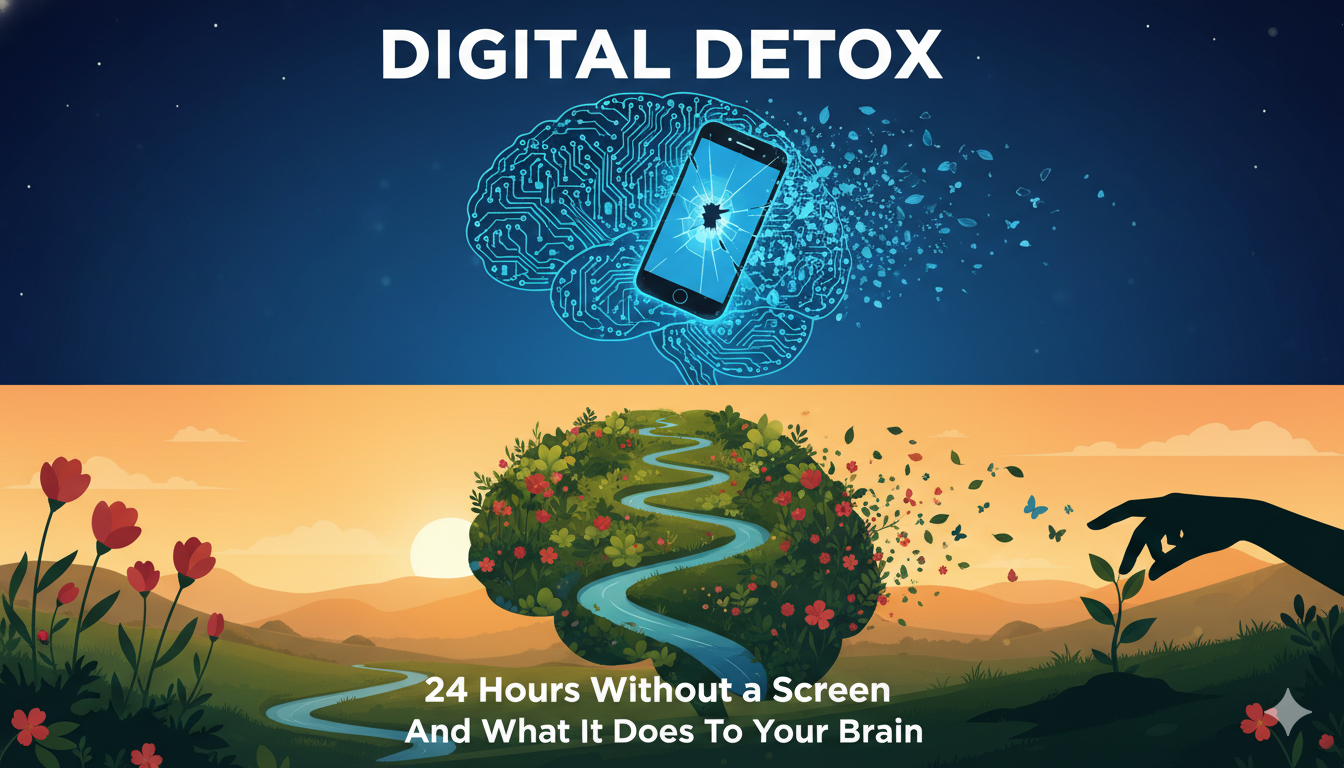
In today’s hyperconnected world, the average person spends several hours a day staring at screens, smartphones, laptops, televisions, and tablets. While technology has undeniably made life more convenient, it has also quietly reshaped the way our brains function. A growing number of people are now experimenting with a simple yet powerful reset: a 24-hour digital detox.
But what actually happens to your brain when you unplug for a full day? Is it just a trendy wellness challenge, or does it produce real neurological and psychological benefits?
This article explores the science behind a digital detox, what happens in your brain during those 24 hours, and why stepping away from screens, even briefly, can dramatically improve your mental health, focus, and emotional balance.
What Is a Digital Detox?
A digital detox is a deliberate break from digital devices such as smartphones, computers, and social media platforms. The goal is to reduce mental clutter, lower stress, and reconnect with real-life experiences.
Unlike long-term lifestyle changes, a 24-hour digital detox is short, achievable, and surprisingly effective. It acts as a reset button for your brain, helping you regain control over attention, emotions, and behavior.
The Brain on Screens: Why We Feel Addicted
Before understanding the benefits of unplugging, it’s important to understand what constant screen exposure does to your brain.
Dopamine and the Reward Loop
Every notification, like, message, or scroll triggers a small release of dopamine—the brain’s “feel-good” neurotransmitter. Over time, this creates a dopamine-driven feedback loop similar to what is seen in behavioral addictions.
Your brain starts craving:
- Instant gratification
- Constant stimulation
- Frequent novelty
This is why you instinctively reach for your phone, even without a clear reason.
Attention Fragmentation
Frequent switching between apps, tabs, and notifications trains your brain to operate in short bursts of attention. This leads to:
- Reduced focus
- Poor memory retention
- Increased mental fatigue
Stress and Cortisol Levels
Constant connectivity keeps your brain in a low-grade state of alertness. Emails, messages, and social media updates act as micro-stressors, increasing cortisol levels, the body’s primary stress hormone.
What Happens During a 24-Hour Digital Detox?
The effects of a digital detox are not just psychological, they are deeply neurological. Here’s what typically happens during those 24 hours.
0–4 Hours: Withdrawal and Restlessness
In the first few hours, your brain reacts as if something essential is missing.
You may experience:
- Urges to check your phone
- Mild anxiety or irritability
- A sense of boredom
This is not weakness, it’s dopamine withdrawal. Your brain is accustomed to constant stimulation and is now adjusting to its absence.
Interestingly, this phase mirrors the early stages of withdrawal seen in behavioral addictions.
4–8 Hours: Mental Slowing and Awareness
As the initial discomfort fades, your brain begins to slow down.
You may notice:
- Reduced mental noise
- Increased awareness of surroundings
- A subtle sense of calm
Without constant input, your brain starts shifting from a reactive mode to a more reflective state.
8–16 Hours: Cognitive Reset Begins
This is where the real transformation starts.
Your brain begins to:
- Restore attention span
- Improve working memory
- Reduce cognitive overload
You may find yourself engaging more deeply in conversations, reading with better comprehension, or simply enjoying silence, something many people rarely experience.
16–24 Hours: Emotional Regulation and Clarity
By the end of the detox, your brain has significantly recalibrated.
Common experiences include:
- Improved mood
- Reduced anxiety
- Greater emotional stability
- Enhanced clarity of thought
This happens because your prefrontal cortex, the part of the brain responsible for decision-making and emotional control, regains dominance over impulsive behaviors driven by constant digital stimulation.
The Science-Backed Benefits of a Digital Detox
A 24-hour digital detox may seem simple, but its effects are backed by neuroscience and psychology.
1. Improved Focus and Attention Span
Studies show that excessive screen time weakens sustained attention. By unplugging, you allow your brain to rebuild its capacity for deep focus.
Even a single day without screens can:
- Enhance concentration
- Improve task completion
- Reduce mental fatigue
2. Reduced Anxiety and Stress
Social media and constant notifications are strongly linked to increased anxiety levels.
A digital detox helps:
- Lower cortisol levels
- Reduce comparison-driven stress
- Promote a sense of calm
3. Better Sleep Quality
Screen exposure, especially at night, disrupts melatonin production due to blue light.
After a 24-hour detox, many people report:
- Falling asleep faster
- Deeper, more restorative sleep
- Improved circadian rhythm
4. Enhanced Emotional Well-Being
Without the constant comparison and validation-seeking behavior associated with social media, your emotional state becomes more stable.
You begin to:
- Feel more content
- Experience less FOMO (fear of missing out)
- Develop healthier self-perception
5. Strengthened Real-Life Connections
A digital detox encourages face-to-face interaction and meaningful conversations.
This leads to:
- Stronger relationships
- Better communication skills
- Increased empathy
Digital Detox and Addiction Recovery
For individuals dealing with behavioral addictions, including social media or even substance use, a digital detox can play a supportive role.
The brain mechanisms involved in digital addiction overlap with those in substance addiction, particularly the dopamine reward system.
Taking a break from screens:
- Reduces triggers
- Improves impulse control
- Enhances self-awareness
In rehabilitation settings, structured digital detox programs are increasingly being used to complement traditional therapies.
How to Successfully Complete a 24-Hour Digital Detox
While the idea sounds simple, many people struggle to actually complete a full day without screens. Here’s how to do it effectively.
Set Clear Intentions
Define why you’re doing this detox:
- Mental clarity
- Reduced stress
- Improved focus
Having a clear purpose increases commitment.
Inform People in Advance
Let colleagues, friends, and family know that you’ll be offline. This reduces anxiety about missing important messages.
Remove Temptations
- Turn off devices or keep them in another room
- Log out of social media accounts
- Disable notifications beforehand
Plan Offline Activities
A successful detox is not about doing nothing, it’s about doing something meaningful without screens.
Consider:
- Reading a physical book
- Exercising
- Journaling
- Spending time in nature
- Engaging in hobbies
Reflect on the Experience
At the end of the 24 hours, take time to reflect:
- How did you feel at the start vs. the end?
- What did you learn about your habits?
- What changes can you sustain?
Common Challenges During a Digital Detox
It’s normal to face resistance during a detox. Some common challenges include:
Fear of Missing Out (FOMO)
You may feel like you’re missing important updates or opportunities. In reality, most of what we consume online is not urgent.
Boredom
Modern brains are not used to stillness. Boredom during a detox is actually a sign that your brain is recalibrating.
Social Pressure
In a connected world, being offline can feel unusual. However, setting boundaries is a powerful step toward mental independence.
Is One Day Enough?
A 24-hour digital detox is not a permanent solution, but it is a powerful starting point.
Think of it as:
- A mental reset
- A way to regain control
- A foundation for healthier digital habits
Many people who try a one-day detox go on to adopt:
- Screen-free mornings or evenings
- Reduced social media usage
- Weekly digital detox routines
Building a Healthier Relationship with Technology
The goal is not to eliminate technology, it’s to use it consciously.
Here are a few long-term strategies:
- Set daily screen time limits
- Use apps intentionally, not habitually
- Create no-phone zones (e.g., bedroom, dining table)
- Schedule regular digital detox days
Final Thoughts
A 24-hour digital detox may seem like a small experiment, but its impact on the brain is profound. In just one day, you can begin to reverse the effects of constant stimulation, restore mental clarity, and reconnect with what truly matters.
Your brain is not designed for endless scrolling, constant notifications, and digital overload. It thrives in moments of stillness, focus, and real-world connection.
Sometimes, the most productive thing you can do is simply disconnect.