As a health professional working on the front lines of substance use disorders, I have seen firsthand the devastating impact that crystal methamphetamine, commonly known as “ICE”, has on individuals and their loved ones. Perhaps the most frightening and misunderstood consequence of this drug is ICE psychosis.
When a family member begins to lose their grip on reality, the experience is nothing short of traumatic. You may feel like the person you knew has vanished, replaced by someone unpredictable, suspicious, and at times, unrecognizable. Understanding the symptoms of crystal meth addiction and the specific indicators of methamphetamine-induced psychosis is the first step toward reclaiming your family’s peace and getting your loved one the help they desperately need.
In this comprehensive guide, we will break down the clinical signs, behavioral red flags, and the psychological “why” behind ICE psychosis to empower you with the knowledge to act.
What Exactly is ICE Psychosis?
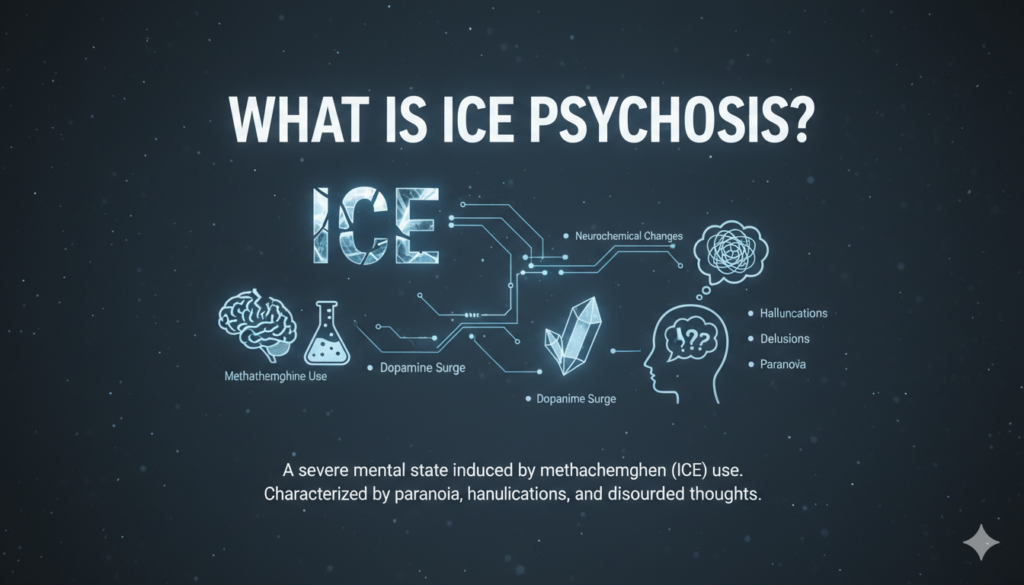
Before we dive into the symptoms, it is crucial to understand what is happening in the brain. ICE (crystal meth) is a potent central nervous system stimulant.[1][2][3][4] It triggers a massive release of dopamine, the brain’s “reward” chemical.[2][4] While a normal pleasurable activity might cause a small bump in dopamine, crystal meth floods the system with up to ten times that amount.
ICE psychosis occurs when this overstimulation causes the brain to misfire. The person enters a state where they can no longer distinguish between what is real and what is not.[4][5][6][7][8] While some experience this only during a high, for many, the psychosis can last for days or even weeks after the drug has left their system.
Symptoms of Crystal Meth Addiction: The Physical Indicators
Identifying addiction often starts with noticing physical changes. Because meth is a “lifestyle-consuming” drug, the toll it takes on the body is rapid and visible. If you are concerned about a family member, look for these key symptoms of crystal meth addiction:
1. The “Meth Mouth.”
One of the most distinct physical signs is severe dental decay.[9] Methamphetamine causes dry mouth (xerostomia) and leads users to crave sugary drinks. Combined with the drug’s acidic nature and the tendency for users to grind their teeth (bruxism), this results in broken, blackened, or rotting teeth.
2. Skin Sores and “Crank Bugs.”
A common hallmark of meth-induced psychosis is formication, the tactile hallucination that insects are crawling under or on the skin. Users will compulsively pick at their face, arms, and legs to “get the bugs out,” leading to open sores, scabs, and eventual scarring.
3. Rapid Weight Loss and Malnutrition
Meth is a powerful appetite suppressant.[10] A person in the throes of addiction may go days without eating, leading to an emaciated appearance, sunken eyes, and a “skeletal” frame.
4. Dilated Pupils and “The Stare.”
During intoxication, a person’s pupils will be significantly dilated, and they may have a “wired” or hyper-alert expression. You might notice rapid eye movements or a fixed, intense stare that feels “empty” or “manic.”
The Behavioral Red Flags: How Families Can Spot the Change
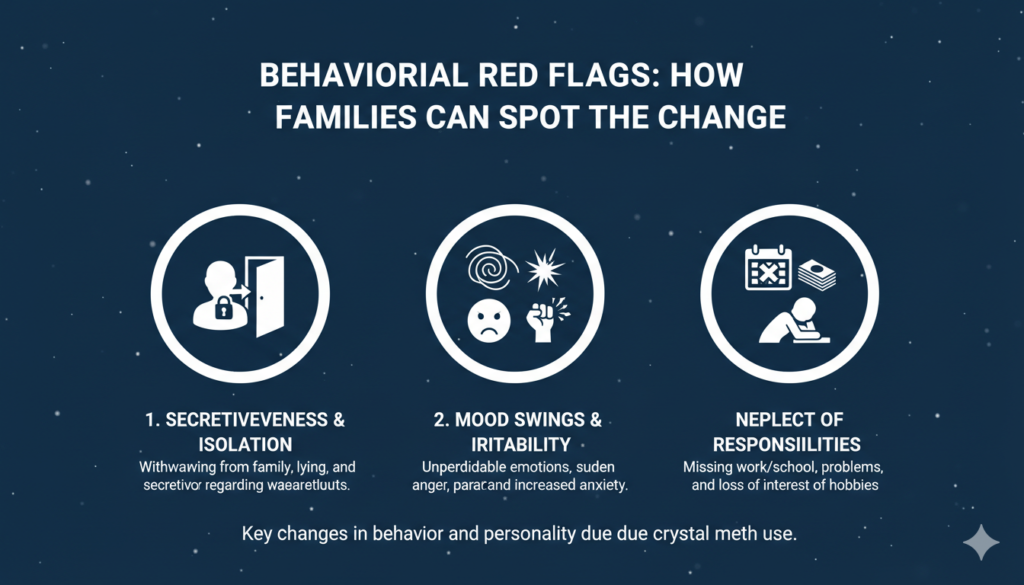
For many families, the behavioral shifts are more jarring than the physical ones. Crystal meth rewires the brain’s impulse control and emotional regulation.
Increased Aggression and Irritability
If your once-gentle family member is suddenly prone to violent outbursts or snaps over minor inconveniences, this is a major red flag. This irritability is often a result of sleep deprivation (users can stay awake for 3–10 days during a “run”) and the chemical fluctuations in the brain.
Compulsive, Repetitive Actions
You might find your loved one disassembling a toaster, cleaning the same floorboard for six hours, or organizing a collection of seemingly random items. These purposeless, repetitive tasks (often called “pundning”) are a direct result of the dopamine flood in the motor centers of the brain.
Neglect of Responsibilities
When addiction takes hold, everything else falls away.[10] Look for:
- Unexplained job loss or skipping school.
- Neglecting personal hygiene (stopping showering or changing clothes).
- Ignoring parental or household duties.[10]
- Financial “emergencies” or disappearing money.
Identifying ICE Psychosis: The Psychological Breakdown
While the general symptoms of crystal meth addiction are concerning, psychosis represents a clinical emergency. If you observe the following three categories of symptoms, your loved one is likely experiencing a psychotic episode.
1. Paranoia and Persecutory Delusions
This is the most common feature of ICE psychosis. The individual may believe:
- The police are watching the house through the vents.
- Family members are “in on a plot” to hurt them.
- Electronic devices are bugged or being used to track their thoughts.
- Neighbors are talking about them behind closed doors.
Note for Families: Do not try to “argue” them out of these delusions. To the person experiencing them, the threat is as real as the floor they are standing on.
2. Hallucinations (All Senses)
While we often think of hallucinations as seeing things (visual), ICE psychosis frequently involves:
- Auditory: Hearing voices that criticize them or command them to do things.[11]
- Tactile: The aforementioned “bugs” under the skin.[2][9]
- Visual: Seeing shadows, “shadow people” in the periphery, or flickering lights.
3. Disorganized Thinking and Speech
You may notice your family member “word-salading” speaking in sentences that don’t make sense or jumping rapidly from one unrelated topic to another. They may seem unable to hold a coherent conversation or follow a simple logical sequence.
Early Warning Signs: Catching It Before the Crisis
As a health professional, I often tell families to trust their “gut.” Often, there is a “prodromal” phase before full-blown psychosis hits. These early symptoms of crystal meth addiction and mental decline include:
- Social Withdrawal: They stop attending family dinners and stay locked in their room or disappear for days.
- Hyper-Vigilance: Constantly checking behind curtains or looking over their shoulder.
- Strange Sleep Patterns: Staying awake for several days followed by a “crash” where they sleep for 24–48 hours straight.
- Moodiness: Extreme “highs” (talking fast, euphoria) followed by deep, dark “lows” (depression, suicidal ideation).
The Difference Between “Being High” and “Psychosis”
It can be difficult for families to tell if their loved one is just “on the drug” or if they have crossed into psychosis.
- Intoxication (The High): Involves high energy, talkativeness, and increased heart rate. The person is still generally aware of who they are and where they are.
- Psychosis: The person has “broken” with reality.[4][5][6][7] Even if they haven’t used it in the last 6 hours, they may still believe the FBI is in the driveway. If the symptoms persist after the drug should have worn off (usually 12–24 hours), it is a sign of methamphetamine-induced psychotic disorder.
How Families Should Handle an ICE Psychotic Episode
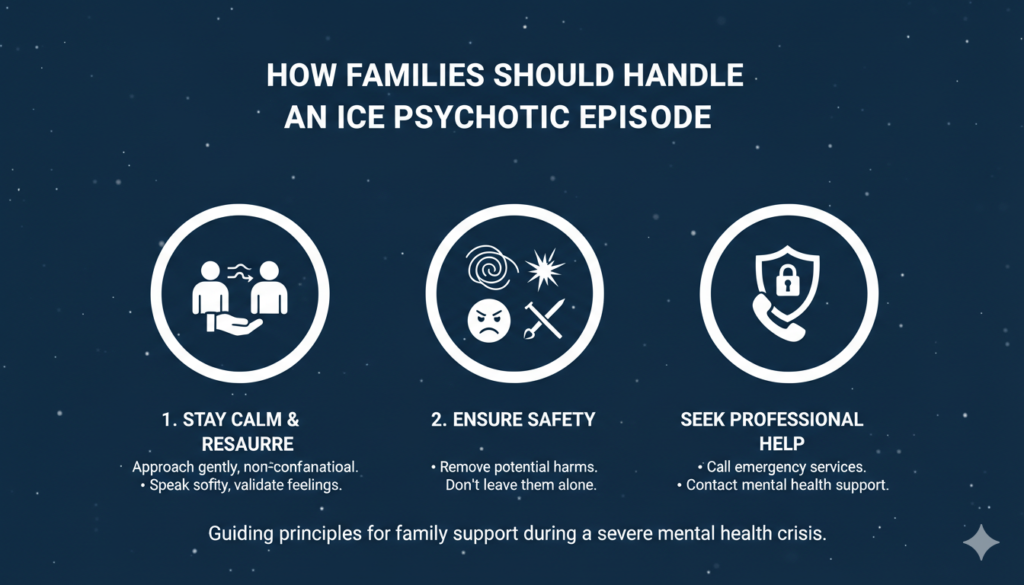
Safety must be your absolute priority. A person with ICE psychosis is not thinking rationally and can become violent if they feel cornered or threatened.[12]
1. Stay Calm and Low-Stimulus
Avoid shouting, bright lights, or crowding the person. Speak in a low, even tone. If they are paranoid, avoid whispering, as they may think you are plotting against them.
2. Do Not Challenge the Delusions
If they say, “The cameras in the ceiling are watching me,” do not say, “That’s ridiculous, there are no cameras.” Instead, say, “I can see that you’re feeling really scared right now. I want to help you feel safe.”
3. Keep Your Distance
If the person becomes agitated, ensure you have a clear path to an exit. Do not try to physically restrain someone on crystal meth; the drug increases physical strength and dulls the sensation of pain.
4. Know When to Call for Professional Help
If they are a danger to themselves or others, you must call emergency services. Specify to the dispatcher that the person is experiencing a substance-induced mental health crisis so that they can send appropriate medical or psychiatric responders.
Long-Term Impact: Can the Brain Recover?
One of the most frequent questions I get from families is: “Will they ever be the same?”
The good news is that the brain is remarkably “plastic” and can heal. However, research shows that chronic meth use can cause long-term changes to the brain’s dopamine and serotonin systems.
- Recovery Timeline: Physical symptoms often improve within weeks. Cognitive functions, like memory and emotional regulation, can take 6 to 18 months of sobriety to fully return.
- Persistent Psychosis: In some cases (roughly 15–25% of heavy users), the psychosis does not fully go away and may develop into a chronic condition like schizophrenia.[7] This makes early intervention and professional treatment vital.
Seeking Treatment: The Path Forward
Addressing the symptoms of crystal meth addiction requires a multi-faceted approach. Because ICE psychosis involves both addiction and mental health symptoms, a “Dual Diagnosis” treatment center is often the best choice.[4]
Medical Detox
The “crash” from meth can involve severe depression and even suicidal thoughts. A medically supervised detox ensures the person is safe and comfortable during the withdrawal phase.
Cognitive Behavioral Therapy (CBT)
CBT is the gold standard for treating meth addiction. It helps the individual identify the triggers that lead to use and teaches them how to rewire their thought patterns.
Family Therapy
Addiction is a family disease. Rebuilding the trust that was shattered during a psychotic episode is a long process. Family therapy provides a safe space for you to express your pain and learn how to support your loved one without enabling them.
Conclusion: You Are Not Alone

Identifying ICE psychosis and the symptoms of crystal meth addiction is a heavy burden for any family to carry. It is easy to feel isolated, embarrassed, or hopeless. But please hear this: Addiction is a medical condition, not a moral failure.
By recognizing the signs early, such as skin picking, dental changes, paranoia, and social withdrawal, you are positioned to intervene before the damage becomes permanent. Your loved one is still in there, buried under the chemical changes of the drug. With the right professional support, the road to recovery is possible.
If you or a family member is in immediate danger, please reach out to your local emergency services or a mental health crisis hotline today.
Frequently Asked Questions (FAQ)
1. How long does ICE psychosis last?
In many cases, the symptoms fade within a few days once the drug wears off and the person gets sleep. However, for some, it can last for weeks or even months.[2] If symptoms persist longer than a month, it may be classified as a primary psychotic disorder.
2. Can you get ICE psychosis the first time you use?
Yes. While it is more common in chronic, heavy users, some individuals are biologically predisposed to psychosis and can experience an episode after just one use.
3. What is the most telling symptom of crystal meth addiction?
While every case is different, the combination of “meth mouth,” sudden extreme weight loss, and intense paranoia is the most common and recognizable sign.
4. Is meth-induced psychosis the same as schizophrenia?
The symptoms, hallucinations, and delusions are almost identical. However, meth-induced psychosis is triggered by a substance, whereas schizophrenia is a chronic mental health condition. Crucially, meth use can “trigger” underlying schizophrenia in people who were already at risk.
5. How can I help a family member who denies they have a problem?
Denial is a part of the disease.[4][13] Focus on the behaviors and your concerns rather than the drug itself. Using “I” statements, such as “I am worried about your health because I’ve noticed you aren’t eating,” can be more effective than “You are a meth addict.” Professional interventionists can also help facilitate these difficult conversations.
Sources